






Feature, Freight News, Logistics, Sea
Belfast unveils plan to become major player in offshore wind
[ January 21, 2025 // Chris Lewis ]Belfast Harbour has launched new five-year strategy to enhance its position as a key player in the development of UK and Ireland’s offshore wind sector.
Advance Regional Prosperity 2025-2029 outlines more than £300m investment in capital projects over the next five years – £208m in port developments and improvements and £105m in the regeneration of the Harbour Estate and waterfront.
The trust port’s plans include the largest single capital project ever undertaken by Belfast Harbour, a proposed £90m investment in a new deepwater quay which will expand the port’s capacity for offshore wind turbine assembly and installation and also be able to accommodate some of the world’s largest cruise vessels.
Belfast Harbour previously invested £53m in its D1 terminal to become the first UK port with a bespoke offshore wind facility and remains the only port on the island of Ireland with such capability, having delivered 66% of the offshore wind projects in UK waters between 2013 and 2018.
The new deepwater berth will allow Belfast Harbour expanding the capacity of its current offshore facility by 2027/28 and develop a terminal to service next generation floating turbines by 2030.
Under the plans, the offshore wind logistics facility at Belfast Harbour’s D1 terminal will again become a full-time offshore wind facility. Cruise ships, which currently dock at the terminal six months of the year, will be relocated to the new deepwater berth at Belfast Harbour’s D3 terminal, which will be used as a dual-purpose site from 2030.
While stage two of the project is dependent on additional investment or third-party funding, Belfast Harbour says that when complete, it will position the port and local supply chain as central to the deployment of high-capacity wind farms. Some 30 offshore wind farms are planned within a 200km range of Belfast.
The Northern Ireland Executive is targeting 1GW of offshore wind from 2030 while the Irish government has targeted 20GW of offshore wind by 2040.
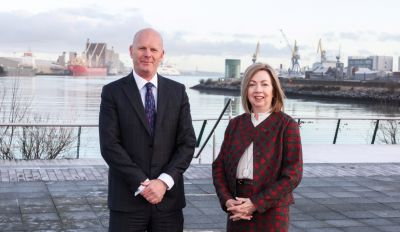
Chair of Belfast Harbour, Dr Theresa Donaldson (pictured, with Belfast Harbour chief executive CEO of Belfast Harbour Joe O’Neill), said: “The wind farms planned for UK and Irish waters over the next decade will be the power stations of the future. They are crucial to meeting the ambitious clean energy targets set out by governments in the UK and Ireland, and will contribute to increased energy security, lower costs and reduce reliance on imported fossil fuels that are subject to global volatility.
“Belfast Harbour also wants to be a key contributor to meeting the UK government and NI Executive targets. Our £90m investment in a new deepwater quay and facilities will support the deployment of the next generation of floating offshore wind farms and allow us to meet the growing needs of offshore renewable energy developers.
“Our expertise and infrastructure, alongside NI’s existing clean energy and advanced manufacturing ecosystem, will support the development of a strong local supply chain that we believe will be viewed favourably when developers are making future investment decisions and considering construction and deployment options for their projects.”
Director of RenewableNI, Steven Agnew, added: “Belfast Harbour is already an excellent resource for renewable energy developers. With a target to reach 80% renewable electricity across the island it is clear we need the infrastructure to match the increased demand. The opportunities for new floating offshore are significant. I am delighted that Belfast Harbour has had the foresight to prepare to take the lead on facilitating the assembly and installation of this vital technology.
Manager of NI Maritime & Offshore (NIMO), Dr Kerry Muldoon, said: “NIMO welcomes the launch of Belfast Harbour’s Strategy for 2025-29 which sets out a bold vision for the continued evolution of the port. With unequivocal commitment to development of a new deepwater quay, it demonstrates Belfast Harbour’s support for the offshore renewables and cruise sectors, both of which play a vital role in our economy. Delivery of this new facility is critical to the long-term success of local companies working in these sectors and can ensure that Northern Ireland plays a critical role in helping to deliver on our net zero ambitions.”
Other significant port projects outlined in the strategy include new, sustainably powered cranes, the planning, design and consent for a rebuild of Stormont Wharf – the port’s main deepwater berth, the construction of new BREAAM Excellent sustainable warehouses and deployment of autonomous vehicles across the port.
Tags: Belfast Harbour; Port of Belfast