










Feature, Freight News, Sea
DFDS celebrates 150 years of bringing home the bacon
[ June 25, 2025 // Chris Lewis ]DFDS is marking the 150th anniversary of the Esbjerg route that has connected Denmark and the UK since 1875.
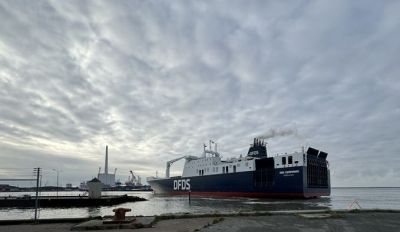
Today, the route handles more than 100.000 single trailers a year. The Ark Dania and Ark Germania operate the route to and from Immingham, offering six weekly departures and a sailing time of 18.5 hours.
While passenger services operated from 1925 to 2014, freight has always been the backbone of the route. In the early days, ships carried live cattle and, by the 20th century, bacon, butter, eggs, and other Danish export staples.
DFDS chief executive Torben Carlsen said: “The Esbjerg–UK route has weathered political shifts, regulatory changes, and economic headwinds, and remains a reliable bridge between Denmark and the UK.”
The route was inaugurated just one year after Esbjerg Harbour opened. The first ship, the paddle steamer Riberhuus, carried live cattle to Thameshaven.
By 1880, the route shifted to Harwich, which had better rail access to London. Over the next decades, screw steamers replaced paddle steamers , and refrigeration technology allowed for the export of processed goods.
World War II disrupted operations. Ships were seized or sunk, and the route was suspended. After the war, the Kronprins Frederik, which had been disassembled and hidden was reinstated and became the first Danish ship with radar. It was joined by Kronprinsesse Ingrid in 1949, and by the early 1950s, DFDS had fully transitioned to motor ships.
In 1964, DFDS introduced the ship England, featuring side ports and a drive-through car deck and in 1967, the Winston Churchill was launched, further improving loading operations with a floating pontoon system and which could carry trailers.
In the 1970s and 1980s, the Dana Regina and later Dana Anglia served the Harwich route, while freight-only services to Grimsby and later Immingham were introduced.
Tags: DFDS