





Feature, Forwarding, Freight News, Logistics
Complex rules stymie warehouse-roof solar power, says Europa
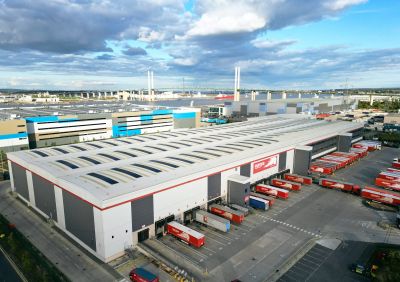
[ October 1, 2026 // Chris Lewis ]Millions of square metres of warehouse roof space across the UK could be used to generate renewable energy, but complex lease arrangements and divided responsibilities between landlords and occupiers are slowing progress said Europa Worldwide group as it announced a plan to install a major system at its Dartford hub.
Europa says it has explored opportunities to install solar at Dartford for several years where its specialist 3PL services create substantial daytime energy demand.
However, the number of parties involved, and the complexity of the process presented significant barriers, it says.
It adds that the UK Warehousing Association (UKWA) has identified grid connection delays, structural considerations, insurance requirements, lease restrictions and a lack of alignment between landlords and tenants as persistent obstacles.
Europa central services director Tom Jenkins said: “We have wanted to utilise solar panels on our Dartford headquarters and transit hub for a long time. The environmental and commercial case is compelling, particularly for a large logistics facility with substantial daytime energy demand, but there are way too many barriers.
“Warehouse occupiers may not own their buildings, while landlords, energy providers, network operators and legal teams all need to be involved. The process can quickly become lengthy and difficult to navigate, even when every party supports the principle of renewable energy.”
Europa Worldwide Group (EWG) has now partnered with its landlord, Prologis, to install a 600 kWp rooftop solar photovoltaic system at Dartford. Expected to generate 541,800 kWh of renewable electricity annually, it is Europa’s first rooftop solar installation and could save the business £80,000 in the first year, at current electricity rates. In its first month of operation, over 40% of the site’s consumption came from solar energy.
Jenkins said: “Our partnership with Prologis has enabled us to overcome those challenges. It shows what can be achieved when landlords and occupiers work closely together, but the wider process needs to become much easier if rooftop solar is to reach its full potential across the logistics sector.”
The installation was led by Jon Margetts, Europa’s head of health and safety and facilities and delivered through a 30-year power purchase agreement with Prologis. This removes the upfront capital expenditure that would otherwise have been required and allows Europa to purchase renewable electricity generated at the site.
Through Prologis Essentials, the property company has provided a turnkey solution, with its energy specialists managing each stage of the project. This has included assessing the site’s energy profile, determining the appropriate system size and overseeing design, approvals, procurement, installation and commissioning.
The agreement runs alongside Europa’s property lease and does not create dilapidation or exit charges should the company leave the building before the solar term ends, removing two potential barriers for the occupier.
Europa says that the project shows what landlords and occupiers can achieve when they work together, while highlighting the practical barriers that must be overcome for rooftop solar to be adopted more widely across the UK warehouse sector.
At a time when the UK must increase renewable energy generation while managing growing pressure on land, warehouse rooftops offer an opportunity to make better use of existing commercial buildings. Around 140 large-scale solar farm schemes were reported to be under construction across the UK in August, with further projects competing for land.
Europa cites UKWA analysis which suggests that existing warehouse rooftops could provide 17.3 GW of solar generating capacity. However, an examination of over 300 warehouse rooftops found that just 5% had solar installed.
Tags: Europa