





Feature, Freight News, Logistics, Road
Maritime Transport puts e-trucks into service
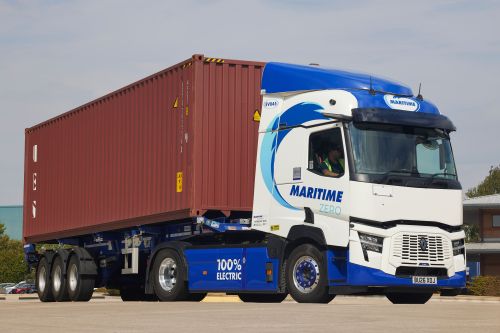
[ October 2, 2026 // Chris Lewis ]Maritime Transport has deployed five Renault E-Tech T trucks in regular service.
They are being delivered as part of the part of the UK Government’s eFREIGHT 2030 Zero Emission HGV and Infrastructure Demonstrator (ZEHID) Programme.
The vehicles are being operated through Maritime ZERO, a dedicated division established in 2025 to oversee Maritime Transport’s zero-emission activity including vehicles, charging infrastructure, software and data. The long-term aim is for Maritime ZERO to be fully integrated into Maritime’s day-to-day operation, rather than remain a separate division.
Initial deployments have included the company’s Wakefield and Avonmouth operations, with the trucks set to move around Maritime’s network as its zero-emission operation develops.
At Wakefield, the E-Tech Ts are being used on first and final mile container movements from Maritime’s inland rail terminal.
Capable of travelling up to 300km on a single charge, the 42-tonne E-Tech Ts are powered by six 90kWh batteries and three electric motors.
EV network manager, Chris Buck, said: “These new Renault Trucks E-Tech Ts have been put straight to work in our operation. If electric HGVs are going to become a viable alternative to diesel, we need to work them hard and understand exactly where and how they perform best.
“We’re currently using the Renault Trucks on first and final mile work from our rail terminals, where we know the routes, payloads and charging opportunities well. As we build our experience and charging network, we’ll continue to look at how we can increase their utilisation across the operation.”
Maritime began introducing eHGVs into its operation in January 2026 and has deliberately selected vehicles from a range of manufacturers, allowing the business to assess how different trucks perform under day-to-day operating conditions before making longer-term fleet decisions.
Deputy chief executive Tom Williams, added: “Electric HGV technology is still developing and we don’t yet know which trucks will prove the best fit for every part of our operation. We wanted to cast the net wide and understand what is available from a range of manufacturers.
“Building that experience across different vehicles will help us better understand their performance and give us the evidence to inform future fleet decisions.”
While the Renault Trucks will predominantly charge overnight at their inland bases, there are opportunities to charge during the day when energy is often at its cheapest. As utilisation increases and the vehicles cover more miles, they will begin drawing on other charge points across Maritime’s national network.
Tags: Maritime Transport