






Feature, Freight News, Sea
The future of shipping is here now, says Höegh chief
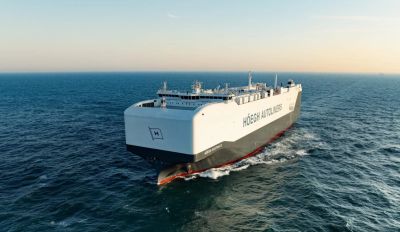
[ November 20, 2026 // Chris Lewis ]Höegh Lines’ latest generation of car-carrying vessels are pointing their way to the future of shipping, Höegh Autoliners chief executive Andreas Enger told a press conference organised by Nor-Shipping. He told the gathering in London on 20 November that the Aurora Class of ships now being introduced by the line would all be ammonia-ready and would be designed for the transition towards lower- and zero carbon fuels.
A dozen of the 9,100CEU (car equivalent unit) ships, the largest of their type ever built, have been delivered or are on order in the existing programme, there are firm orders for a further six in 2029-31, there are options for four more and shipyards slots reserved for a further four.
On 9 November Höegh Autoliners signed a strategic and technical cooperation agreement with BYD Energy Storage to install its battery technology on board Aurora No. 12.
She will be the first deep-sea car carrier to combine all available green technology on board, with energy storage batteries, a shaft generator and solar panels working as an integrated system and ammonia as fuel from the day it leaves the yard. The vessel is scheduled for delivery and to commence commercial services in May 2028.
Enger said that with geopolitics reshaping global trade and supply chains, resilience and futureproofing would be more important than ever in shipping. The new class of ship meant that Höegh would be able to operate 60% of its capacity carbon-free by 2035.
Bunkering of ammonia had not proved to be as big a problem as some had suggested, he added, in answer to a question from FBJ. While little ammonia was available in Europe, China was ramping up ammonia production and its ports were providing the fuel on a large scale and there were similar projects underway in other ports such as Singapore. Bunkering or ammonia was relatively straightforward for a liner service, but he conceded that it would be more of an issue for tramp operators.
Currently, around a third of the new ships’ operation was with ammonia and the price of the fuel had reduced and in fact the decision to use it was a commercial one, not to satisfy a ‘green’ agenda. Ammonia prices had reduced to the point where ship operators may decide to use it for financial reasons rather than being forced to do so by regulation.
Tags: Hoegh